Imām Abū Mansūr al-Māturīdī: His illustrious teachers and students
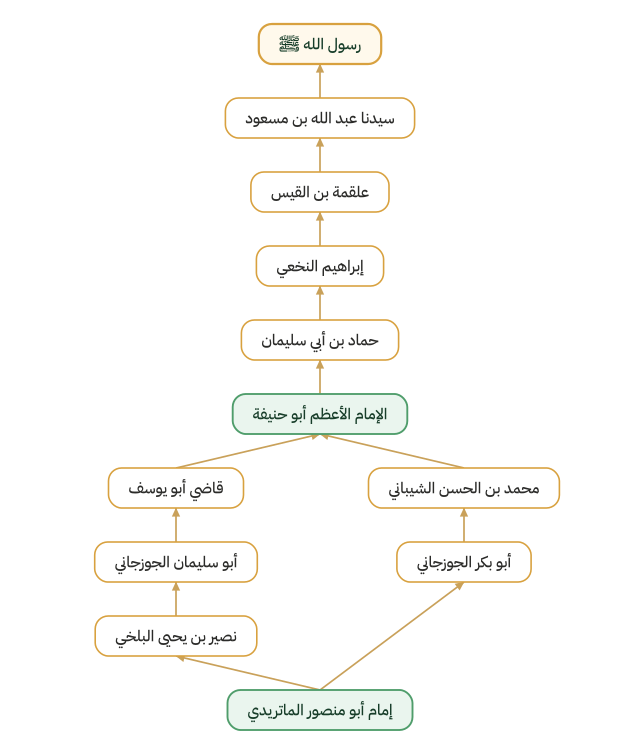
Detailed information on the biographies of the early proponents of the Māturīdī Samarqandī tradition is very scarce. Due to this, knowledge of the predecessors and successors of Imām al-Māturīdī and more importantly, the reception of his teachings and their influence is not known in detail. Yet these matters are of the utmost importance in helping us understand the intellectual milieu in which Imām al-Māturīdī developed his theological system. The information that is available is mostly to be found in the Hanafī Ṭabaqāt works such as Imām al-Laknawī’s Al-Fawāʾid al-Bahiyyah fī tarājim al-Ḥanafiyyah and and Imām Abd al-Qādir al-Qurashī’s Al-Jawāhir al-Mudīʾah fi Ṭabaqāt al-Ḥanafiyyah. These sources mention the names of the teachers and students of Imām al-Māturīdī as well as brief details of their works. Alongside these works, the early Māturīdī works such as Imām Abū Salama al-Samarqandī’s Jumal min Uṣūl al-Dīn and its commentary written by Imām Muhammad ibn Yahyā al-Bashāgharī also include some finer details which are crucial in helping us understand the early Samarqandī theological school. From the later works, it is well known that the most authoritative and detailed exposition of Imām al-Māturīdī’s theology can be found in Imām Abū al-Muīn al-Nasafī’s Tabsirat al-Adillah fī Uṣūl al-Dīn. There, we can also find some details on the scholarly calibre, intellectual fortitude and piety of the early Samarqandī scholars. Despite the scarcity of information, one thing is clear; the Māturīdī Samarqandī tradition is an inheritance of the theology, law and piety of Imām Abū Hanīfa and his students. Each of the teachers of Imām al-Māturīdī were all either grand or great grand students of Imām Abū Hanīfa through his two most senior students, Imām Abū Yūsuf and Imām Muhammad al-Shaybānī. Affirming this Hanafī inheritance, Imām Abū Salama al-Samarqandī mentions biographical details of the early Samarqandī imams at the end of his work Jumal min Uṣūl al-Dīn and remarks,
The objective of my mentioning these great imams at the end of this book is for it to be known that the selection of this upright tradition is not from the mere fabrications of the mind nor the inventions of the whim. Rather, it is through following the way of the predecessors and their predecessors until the Messenger of Allāh in the form of sincere advice from the scholars, compassion for the ummah and preservation of the rights of Islam.
Predecessors here very clearly refers to the early Samarqandī masters who transmitted the creed and at the foremost of them was Imām al-Māturīdī. The Hanafī connection between the theological system of Imām al-Māturīdī and his predecessors is a matter to be explored in another article. Here, we will be introduced to the illustrious teachers and students of Imām al-Māturīdī.
Teachers:
There is no doubt that a scholar of the calibre of Imām al-Māturīdī would have had many teachers. However, from the scarce information that is available to us, there are a few names who can be determined as the most prominent teachers of the Imām.
1. Muhammad ibn Muqātil al-Rāzī (d.248/862)
He was the chief judge of Rayy, an ancient city near modern-day Tehran, yet Imām al-Bukhārī when asked about him is reported to have said, “For me to fall from the sky to the earth is more beloved to me than to narrate from Muhammad ibn Muqātil al-Rāzī”.[1] Ibn Hajar comments on this statement of Imām al-Bukhārī stating, “I believe that this (criticism) was from the perspective of him being a person of reason (aẓunnu anna dhālika min qibal al-raiʾyy)”.[2] This is why Imām Abū al-Yusr al-Bazdawī states, “As for those who criticise Muhammad ibn Muqātil and say that the narrations of such and such person are not accepted, or that such and such is weak and has been declared weak by so and so, then the narrations of these narrators will not be rejected until the reason of criticism is clarified”.[3] Therefore, though the Imām has been criticised for being a person of reason, this does not necessitate that he is unreliable in religious matters. Despite the criticism regarding the Imām from the scholars of hadith, his position as an expert Hanafī jurist is unquestioned such that Ibn Hajar mentions, “He was from the senior jurists (al-fuqahā al-kibār)”.[4] This is no surprise as he was from the students of the great Imām Muhammad ibn al-Hasan al-Shaybānī.
2. Nusayr ibn Yahyā al-Balkhī (d.268/881)
He is mentioned to be amongst the teachers of Imām al-Māturīdī by Imām al-Bayādī.[5] Not much is known about him except that he was a student of Imām Abū Sulaymān al-Jūzajānī who in turn was a student of Imām Muhammad al-Shaybānī. Additionally, it is noted that he met with Imām Ahmad ibn Hanbal and studied with him (ijtamaʿa maʿa Ahmad ibn Hanbal wa baḥatha maʿahū).[6]
3. Abū Bakr Ahmad ibn Ishāq al-Jūzajānī (d.250/864)
Imām Abū Muīn al-Nasafī mentions him as the teacher of Imām al-Māturīdī stating that, “The Shaykh was a companion of Abū Sulaymān al-Jūzajānī, student of Imām Muhammad al-Shaybānī. He possessed the highest rank and loftiest status in many of the religious sciences. Whoever read his books such as Al-Farq wa al-Tamyīz and Al-Tawbah, came to know his mighty rank”. Similarly, Imām Abd al-Hayy al-Laknawī mentions, “He was a scholar who gathered the knowledge of the secondary matters of law and its principles”.[7]
4. Abū Nasr Ahmad ibn al-Iyāḍī (d. before 103)
Imam al-Laknawī mentions that
He was from the lineage of Saʿd ibn ʿUbādah al-Ansārī al-Khazrajī, the companion of Allāh’s Messenger. He learnt law alongside Imām Abū Mansūr al-Māturīdī from Imām Abū Bakr Ahmad ibn Ishāq al-Jūzajānī from Imām Muhammad al-Shaybānī. He died a martyr and the story behind that is that the border of Islām was at Isbījāb and so he went with his son Abū Ahmad whilst he was a young man to the battle. The enemies imprisoned him and killed him.[8]
In the Tabsirat al-Adillah we find more details on the life of this great Imām. Imām al-Nasafī mentions him regarding him;
He was martyred as he was persistent upon fighting against the enemies of Allāh. He was also the bravest of the people of his time, the most collected in times of fear and the most unyielding of them. In his knowledge he was a bottomless ocean, an imam in the matters of law and the principles such that none equated to him. Whoever read his book on the attributes and proofs regarding the authenticity of the positions of people of truth and refutation of the Mu’tazila, could recognise his oceanic knowledge.[9]
Imām al-Nasafī also mentions from Imām Abū al-Qāsim al-Hakīm al-Samarqandī that he said,
No person of innovation, misguidance and argumentation in the religion came to the jurist Abū Naṣr al-Iyādī with a verse of the Qurʾān which they used to argue their position except that the Imām would bring (a response) that would silence and decimate the innovator of the position.[10]
Concerning his calibre of scholarship and teaching, al-Nasafī mentions from al-Samarqandī that “the position of authority amongst the scholars and in teaching belonged to him (Imām Abū Nasr) whilst he was in his twenties”.[11] In fact his calibre and strength of scholarship was such that he was considered the proof of the authenticity of Imām Abū Hanīfa’s school. Al-Nasafī mentions from Imām Abū Hafs al-Ijlī al-Bukhārī that he used to say, “The proof that the position of Imām Abū Hanīfa was correct is the fact that Imām Abū Nasr Ahmad al-Iyādī used to believe his position and he would never adhere to a false position”.[12] Likewise, al-Nasafī mentions from Shaykh Abū al-Qāsim al-Hakīm that he would say, “Noone has come from Khurasān and neither from the Transoxiana region like the Jurist, Abū Nasr Ahmad al-Iyādī in terms of knowledge, understanding, words, actions, purity, and piety since one hundred years”. It would be said in response to Abū al-Qāsim al-Hakīm, “Allah have mercy on you! Who rivalled him in the previous hundred years?”.[13] These statements all indicate to the great rank and prominence that Imām Abū Nasr ibn al-Iyādī held amongst the early Samarqandī masters.
Students:
Before mentioning the students of the Imām, it is important to know that Imām al-Māturīdī held the head teaching post at the Dār al-Jūzajāniyyah madrasah. As such, Imām Abū al-Yusr al-Bazdawī mentions in his Uṣūl al-Dīn that the imam taught the Hanafī books, the Kitāb al-Tawhīd and the Taʾwīlāt to a huge number of students. However, the Ṭabaqāt books and the sources that are available to us only mention the most prominent of them.
1. Abū al-Qāsim al-Hakīm al-Samarqandī (d. 342/953)
Though the Imām was a contemporary of Imām al-Māturīdī and shared the same teachers as him, he is also known to have studied under al-Māturīdī himself. Imām al-Laknawī writes,
He studied law (fiqh) with Imām Abū Mansūr and was given the title al-Ḥakīm due to his wisdom and admonitions. He accompanied Imām Abū Bakr al-Warrāq along with the senior scholars of Balkh and took spirituality (taṣawwuf) from them. He was from the righteous servants of Allāh and amongst the exemplars of wisdom and good conduct. He took the role of judge of Samarqand for a long period of time. He died in Muharram on the day of Āshūrā in the year 342.[14]
Al-Hakīm al-Samarqandī has written many beneficial works in kalām, many of which are still available today. Amongst them are Al-Sawād al-Aẓam, which contains sixty-two statement of sunnī creed and was commissioned by Ismāīl ibn Ahmad, the founder of Samanid polity in Transoxiana. The work was commissioned to uphold the parameters of sunnī orthodoxy. He also wrote Al-Hikmah al-Nabawiyyah, a commentary on the Al-Fiqh al-Akbar of Imām Abū Hanīfa.
2. Abd al-Karīm al-Bazdawī (d. 390)
The name Bazdawī speaks for itself in the realm of classical scholarship and usually is understood to refer to the great Hanafī Imam Fakhr al-Islām Alī ibn Muhammad al-Bazdawī, the author of Kanz al-Wusūl ilā marifat al-Usūl and less frequently to his brother, Abū al-Yusr Al-Qādī al-Sadr Muhammad ibn Muhammad al-Bazdawī, who was the author of the famous Hanafī kalām work entitled Uṣūl al-Dīn. Seldom do we hear about their grandfather who was a direct student of Imām al-Māturīdī. Regarding this Imām Bazdawī writes in his Uṣūl al-Dīn, “Our grandfather took the knowledge of the books of our Hanafī scholars, Kitāb al-Tawhīd and the Taʾwīlāt from Imām al-Māturīdī”.[15] Knowledge of the tradition in the Bazdawī lineage began with this noble grandfather which is why Imām al-Laknawī writes, “He left behind a righteous lineage as his children and grandchildren were all from the people of knowledge who served the Hanafī and Māturīdī schools”.[16]
3. Alī ibn Saīd al-Rustughfanī (d. approx. 350)
Not a great deal is mentioned about him in the Tabaqāt works except that he was “from the senior scholars of Samarqand”,[17] and that he wrote a few works such as the Irshād al-Muhtadī and the Kitāb al-Zawāʾid wa al-Fawāʾid fī aṣnāf al-Ulūm. Imām al-Kashshī has compiled a collection of fatāwa written by scholars of the Transoxiana region entitled, Majmū al-Nawāzil wa al-hawādith wa al-wāqiāt. The penultimate chapter to this work is entitled Bāb al-mutafarriqāt min al-Fawāʾid which contains Imām al-Rustughfanī’s answers to many questions. Imām al-Kashshī refers to this chapter as an abridgement of the Kitāb al-Zawāʾid. This is an interesting piece of work since it contains theological content on Allāh’s attributes, Prophecy, Human faith and action as well as matters of the unseen. The matters of creed are characteristic of the Māturīdī Samarqandī madrasah of theology. It is also perhaps the earliest Māturīdī Samarqandī text to use the term Ahl al-Sunnah wa al-Jamaah as a label of identity. These writings can give us an understanding of the early Samarqandī madrasah of theology and the views of the successors of Imām al-Māturīdī.
It should also be known that Imām al-Rustaghfanī was the teacher of Imām Muhammad ibn Yahyā al-Bashāgharī, who in turn was the son of Imām Abū Zakariyyā Yayhā al-Bashāgharī. Imām Abu Zakariyya was amongst the forty graduates of Imām al-Māturīdī’s teacher Imām Abū Nasr al-Iyādī and Imām Māturīdī’s class fellow. We can deduct from this that Imām al-Rustughfanī was a successor to Imām al-Māturīdī and Imām Abū Zakariyya in teaching. This must have been at the Dar al-Jūzajāniyyah madrasah, since Imām al-Māturīdī held the head teaching post there after his teacher Imām Abū Nasr Ahmad ibn al-Iyādī.
4. Abū Ahmad Nasr ibn al-Iyādī
The son of Imām al-Māturīdī’s teacher Abu Nasr Ahmad ibn al-Iyādī. Abū Salama al-Samarqandī, a student of Abu Ahmad describes his story in detail at the end of his Jumal min Uṣūl al-Dīn. He mentions that Imām Abū Nasr was martyred whilst in captivity and his son Abū Ahmad was released and returned to Samarqand to study with his father’s students. It is reported that he was instructed by his father to study with the forty graduates he left behind, amongst whom was Imām al-Māturīdī and take knowledge from them. As such he studied under them until he became a great scholar himself, so much so that Imām Abū Mansūr and the other scholars of Samarqand gave him the seat of his father in the madrasah Dar al-Jawzjāniyyah and would honour him since his father was their teacher. He also mentions that Imām Abū Ahmad would honour Imām al-Māturīdī as a student would honour a teacher because of Imām al-Māturīdī’s special rank in knowledge and piety.[18]
Concluding remarks
Through knowing the teachers and students of Imām al-Māturīdī, we are drawn closer to understanding the makings of the Imām himself as well as the legacy that he left behind. As mentioned, the Imām is no doubt an inheritor of Imām Abū Hanīfa; this is something that is clear from the accumulated knowledge on his teachers. The early Samarqandī masters all demonstrated a deep commitment to the teachings of their great grand teacher and had a great sense of pride in being his intellectual and spiritual inheritors. Yet Imām al-Māturīdī’s writings demonstrate a more complex and detailed theological system, one that has its own theological aims and is responding to a very particular intellectual environment. The extent of this inheritance is something that requires study so that we may unearth the extent of this Hanafī influence and its role in shaping the views of Imām al-Māturīdī.
[1] Ibn Hajar al-Asqalānī, Lisān al-Mizān (Dār al-Bashāʾir al-Islāmiyyah), 7:517.
[2] Ibn Hajar, Lisān al-Mizān, 7:517.
[3] Abū al-Yusr Muhammad al-Bazdawī, Marifat Al-Hujaj al-Shariʿyyah (Al-Maʾhad al-Ilmī al-Faransī li al-Āthār al-Sharqiyyah, 2003).
[4] Ibn Hajar, Lisān al-Mizān, 7:517.
[5] Kamāl al-Dīn al-Bayādī, Ishārāt al-Marām min Ibārāt al-Imām,
[6] Abd al-Qādir al-Qurashī al-Hanafī, Al-Jawāhir al-Muḍīʾah fī Ṭabaqāt al-Hanafiyyah, 2nd edn (1993; Dār Hijr, n.d.).
[7] Abd al-Hayy al-Laknawī, Al Fawāʾid al-Bahiyyah fī Tarājim al-Hanafiyyah (Dār al-Kitāb al-Islāmī, n.d.).
[8] Al-Laknawī, Al-Fawāʾid al-Bahiyyah.
[9] Abū al-Mu’īn al-Nasafī, Tabșirat al-Adilla fī Usūl al-Dīn, (Al-Jaffan&Al-Jabi, 1990) 1:357.
[10] Al-Nasafī, Tabșirat al-Adillah, 1:357.
[11] Al-Nasafī, Tabșirat al-Adillah, 1:357.
[12] Al-Nasafī, Tabșirat al-Adillah, 1:357.
[13] Al-Nasafī, Tabșirat al-Adillah,1:357.
[14] Al-Laknawī, Al-Fawāʾid al-Bahiyyah, 44.
[15] Abū al-Yusr Muhammad al-Bazdawī, Usūl Al-Dīn (2005; Al-Maktabah al-Azhariyyah li al-Turāth, n.d.), 14.
[16] Al-Laknawī, Al-Fawāʾid al-Bahiyyah.
[17] Al-Qurashī, Al-Jawāhir.
[18] Abū al-Husayn Muhammad ibn Yahya al-Bashāgharī, Sharh Al-Jumal Min Usūl al-Dīn (Dār al-Nūr al-Mubīn, 2025) 363.